Introduction
Artificial intelligence has transformed the way people communicate, work, study, and create content. Among the most significant innovations in recent years are AI chatbots—intelligent virtual assistants capable of answering questions, generating text, writing code, summarizing information, brainstorming ideas, and even helping with customer service.
In 2026, AI chatbots are no longer limited to simple question-and-answer interactions. They have become sophisticated productivity tools used by students, businesses, marketers, developers, educators, healthcare professionals, and everyday consumers.
Whether you need help drafting emails, researching a topic, learning a new skill, automating business tasks, or generating creative content, there is an AI chatbot designed for your needs. This guide explores the best AI chatbots available today, their key features, advantages, disadvantages, and how to choose the right one.
What Is an AI Chatbot?
An AI chatbot is software powered by artificial intelligence and natural language processing (NLP) that understands human language and generates conversational responses.
Unlike traditional rule-based chatbots that rely on predefined scripts, modern AI chatbots learn from vast amounts of data and can respond intelligently to a wide range of prompts.
Common capabilities include:
- Writing articles and blog posts
- Answering questions
- Coding assistance
- Language translation
- Brainstorming ideas
- Summarizing documents
- Creating marketing copy
- Generating emails
- Tutoring students
- Customer support automation
Why AI Chatbots Are So Popular
The rapid growth of AI chatbots is driven by their ability to save time and improve productivity.
Major benefits include:
- 24/7 availability
- Fast responses
- Reduced workload
- Improved creativity
- Cost-effective automation
- Personalized assistance
- Better customer experiences
- Support for multiple languages
Businesses use AI chatbots to handle customer inquiries, while individuals rely on them for writing, studying, programming, and daily planning.
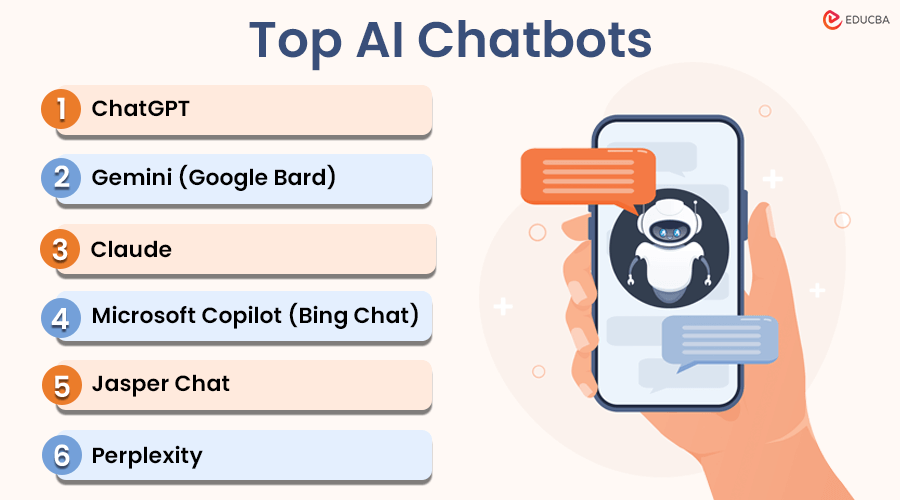
Top AI Chatbots in 2026
1. ChatGPT
ChatGPT is among the most widely recognized AI assistants available today. It helps users write content, answer questions, solve programming challenges, summarize documents, brainstorm ideas, and assist with research.
Strengths:
- Excellent conversational abilities
- Strong writing support
- Coding assistance
- Educational help
- Business productivity features
- Creative brainstorming
Ideal for:
- Students
- Bloggers
- Marketers
- Developers
- Small businesses
- Researchers
2. Google Gemini
Google Gemini integrates advanced AI capabilities with Google’s ecosystem. It is especially useful for research, productivity, and document creation.
Key features:
- Information summarization
- Writing assistance
- Research support
- Workspace integration
- Brainstorming tools
Best for:
- Office productivity
- Students
- Business users
3. Claude
Claude focuses on thoughtful, detailed, and context-aware conversations. Many users appreciate its ability to process long documents and generate structured responses.
Advantages:
- Long-context understanding
- Detailed explanations
- Professional writing
- Analytical tasks
Ideal users:
- Writers
- Analysts
- Researchers
- Legal professionals
4. Microsoft Copilot
Microsoft Copilot integrates AI into productivity software and development workflows. It supports document creation, coding assistance, spreadsheet analysis, and workplace automation.
Popular uses:
- Office documents
- Programming
- Data analysis
- Workplace productivity
5. Perplexity AI
Perplexity AI combines conversational AI with search-based responses, making it useful for users seeking referenced answers and research assistance.
Highlights:
- Research-oriented responses
- Information discovery
- Quick summaries
- Educational support
6. Grok
Grok offers conversational AI capabilities with a focus on current discussions, brainstorming, and engaging interactions.
Common applications:
- General knowledge
- Creative writing
- Technology discussions
- Everyday assistance
AI Chatbots for Students
Students increasingly rely on AI chatbots to improve learning and academic productivity.
Useful tasks include:
- Explaining difficult concepts
- Creating study guides
- Summarizing textbooks
- Practicing language skills
- Solving programming exercises
- Generating quiz questions
- Writing outlines
- Brainstorming project ideas
Students should still verify facts and follow their institution’s academic integrity policies.
AI Chatbots for Businesses
Organizations use AI chatbots to automate repetitive work and improve customer experiences.
Business applications include:
- Customer support
- Lead generation
- FAQ automation
- Appointment scheduling
- Internal knowledge management
- Marketing copy creation
- Email drafting
- Sales assistance
Companies adopting AI responsibly can reduce costs while improving response times.
AI Chatbots for Content Creation
Content creators use AI to speed up production without replacing human creativity.
AI chatbots can help generate:
- Blog outlines
- Social media captions
- Product descriptions
- SEO-friendly drafts
- Email newsletters
- Video scripts
- Podcast ideas
- Advertising copy
Human editing remains essential for originality, accuracy, and brand voice.
AI Chatbots for Programming
Developers benefit from AI assistants during coding and debugging.
Typical coding tasks include:
- Writing sample code
- Explaining algorithms
- Finding bugs
- Generating documentation
- Refactoring functions
- Learning new frameworks
- SQL query assistance
- API usage examples
AI should complement testing and code reviews rather than replace them.
How to Choose the Best AI Chatbot
When selecting an AI chatbot, consider the following factors:
Purpose
Determine whether you need help with writing, coding, research, education, or business automation.
Accuracy
Check responses carefully, especially for technical, financial, legal, or medical topics.
Ease of Use
Choose a chatbot with a clean interface and intuitive interaction style.
Pricing
Many platforms offer free versions alongside paid subscriptions with expanded capabilities.
Integrations
Some AI assistants connect with productivity tools, cloud storage, or workplace software.
Privacy
Review how your data is handled and avoid sharing confidential information unless appropriate safeguards are in place.
Advantages of AI Chatbots
Some major benefits include:
- Increased productivity
- Faster research
- Better brainstorming
- Improved writing efficiency
- Reduced customer support costs
- Continuous availability
- Scalable assistance
- Personalized interactions
These advantages make AI chatbots valuable across education, business, and personal use.
Limitations of AI Chatbots
Despite rapid progress, AI chatbots have limitations.
Potential drawbacks include:
- Occasional factual errors
- Outdated information in some contexts
- Misunderstanding complex prompts
- Limited domain expertise
- Bias inherited from training data
- Need for human verification
- Privacy considerations
- Overreliance by users
Critical decisions should not rely solely on AI-generated responses.
Best Practices for Using AI Chatbots
To get better results:
- Write clear prompts.
- Provide sufficient context.
- Break large tasks into smaller steps.
- Verify important facts independently.
- Revise AI-generated drafts.
- Avoid sharing sensitive personal or confidential data.
- Experiment with follow-up questions.
- Combine AI assistance with human judgment.
The Future of AI Chatbots
AI chatbots continue to evolve rapidly. Future developments are likely to include:
- More personalized interactions
- Better reasoning capabilities
- Enhanced multimodal understanding
- Improved voice conversations
- Deeper workplace integrations
- Stronger collaboration features
- Greater automation of routine tasks
- Expanded accessibility features
As the technology matures, AI chatbots are expected to become an even more integral part of education, business, healthcare, software development, and everyday productivity.
Frequently Asked Questions
Are AI chatbots free?
Many AI chatbots offer free plans with optional premium subscriptions that unlock additional features and higher usage limits.
Can AI chatbots replace human writers?
They can accelerate drafting and brainstorming, but human review is still important for accuracy, creativity, and nuanced judgment.
Are AI chatbots useful for coding?
Yes. They can explain concepts, generate examples, identify bugs, and assist with documentation, though developers should test and validate outputs.
Which industries benefit most from AI chatbots?
Education, customer service, marketing, software development, finance, retail, and healthcare all make use of AI-powered conversational tools in various ways.
Conclusion
AI chatbots have become indispensable digital assistants that help individuals and organizations accomplish more in less time. From writing and coding to research, education, and customer support, these tools are reshaping how work gets done.
The best AI chatbot depends on your goals, workflow, and preferences. Some excel at creative writing, others at technical assistance or research, and many provide a balance of capabilities suitable for everyday productivity. By using AI responsibly and verifying important information, users can take advantage of these technologies while maintaining quality and accuracy.
As innovation continues, AI chatbots are poised to become even smarter, more collaborative, and more deeply integrated into daily life, making them one of the most influential technologies of the modern digital era.