Introduction
Artificial Intelligence (AI) has evolved from a futuristic concept into one of the most influential technologies of the 21st century. From virtual assistants and recommendation engines to autonomous vehicles and advanced medical diagnostics, AI is already shaping how people live and work. As computing power grows, data becomes more abundant, and machine learning models become increasingly sophisticated, the future of artificial intelligence promises even greater changes across industries and societies.
Businesses are using AI to automate operations, improve customer experiences, and make better decisions. Students rely on AI-powered learning platforms for personalized education. Healthcare providers leverage AI to detect diseases earlier and support treatment planning. Governments, researchers, and entrepreneurs continue investing billions of dollars into AI innovation, making it one of the fastest-growing sectors in technology.
Yet the future of AI is about more than automation. It represents a shift toward intelligent systems that can collaborate with humans, solve complex problems, and accelerate scientific discovery. At the same time, it raises important questions about ethics, privacy, security, employment, and governance.
This article explores the future of artificial intelligence, its emerging trends, opportunities, challenges, and the profound impact it is likely to have on business, education, healthcare, transportation, creativity, and everyday life.
Understanding Artificial Intelligence
Artificial Intelligence refers to computer systems designed to perform tasks that typically require human intelligence. These tasks include recognizing speech, understanding language, identifying patterns, making decisions, solving problems, and learning from experience.
Modern AI includes several major branches:
- Machine Learning
- Deep Learning
- Natural Language Processing
- Computer Vision
- Robotics
- Reinforcement Learning
- Generative AI
Unlike traditional software that follows fixed rules, AI systems improve through exposure to data and feedback. This capability allows them to adapt to changing conditions and deliver increasingly accurate predictions or responses.
Why AI Is Growing So Quickly
Several technological developments have accelerated AI adoption:
Massive Computing Power
Cloud computing and specialized processors enable developers to train complex AI models much faster than in the past.
Data Availability
Digital interactions generate enormous amounts of data every second. AI systems learn from this information to improve performance and discover patterns.
Better Algorithms
Continuous advances in neural networks and optimization techniques have significantly improved AI capabilities in language, vision, reasoning, and prediction.
Business Demand
Organizations seek greater efficiency, lower costs, and better customer experiences. AI offers practical solutions for achieving these objectives.
Global Investment
Governments, technology companies, startups, and research institutions are investing heavily in AI research and infrastructure, fueling rapid innovation.
The Future of AI in Healthcare
Healthcare is expected to experience some of the most significant AI-driven transformations.
Early Disease Detection
AI systems can analyze medical images and patient data to identify diseases earlier than traditional methods, potentially improving treatment outcomes.
Personalized Medicine
Future AI platforms may recommend individualized treatments based on genetics, lifestyle, and medical history.
Drug Discovery
Developing new medications traditionally requires years of research. AI can analyze biological data and identify promising compounds more quickly, accelerating pharmaceutical development.
Remote Patient Monitoring
Wearable devices combined with AI can continuously monitor vital signs, detect abnormalities, and notify healthcare professionals when intervention is needed.
Administrative Efficiency
Hospitals can automate scheduling, documentation, billing, and patient communication, allowing healthcare professionals to focus more on patient care.
AI in Education
Education is becoming increasingly personalized through artificial intelligence.
Adaptive Learning
AI platforms adjust lessons according to each student’s strengths, weaknesses, and pace of learning.
Intelligent Tutoring
Virtual tutors can answer questions instantly, provide explanations, and generate customized practice exercises.
Automated Assessment
Teachers save time through AI-assisted grading and feedback systems while gaining deeper insights into student performance.
Language Learning
Speech recognition and conversational AI create immersive environments for practicing new languages.
Accessibility
Students with disabilities benefit from AI-powered captioning, speech-to-text systems, and personalized learning tools that reduce barriers to education.
AI in Business and the Workplace
Companies across industries are integrating AI into daily operations.
Customer Support
AI chatbots provide 24-hour assistance, reducing wait times and handling routine inquiries efficiently.
Marketing
Predictive analytics help businesses understand customer preferences and create personalized campaigns.
Human Resources
Recruitment tools can analyze resumes, identify qualified candidates, and streamline hiring processes.
Financial Forecasting
AI models analyze historical and real-time data to support budgeting, forecasting, and investment decisions.
Supply Chain Optimization
Businesses use AI to predict demand, optimize inventory, reduce waste, and improve logistics.
The Rise of Autonomous Systems
Autonomous technology will become increasingly common.
Self-Driving Vehicles
Future transportation systems may feature AI-powered cars capable of navigating safely with minimal human intervention.
Delivery Drones
Autonomous drones could handle package deliveries, emergency supplies, and remote logistics.
Industrial Robots
Factories are adopting intelligent robots that collaborate safely with human workers while increasing productivity.
Agricultural Automation
AI-powered equipment can plant crops, monitor soil conditions, detect pests, and optimize irrigation.
Generative AI and Creative Industries
Generative AI has already demonstrated its ability to produce text, images, music, videos, and software code.
Content Creation
Writers and marketers use AI for brainstorming, drafting, summarization, and editing while maintaining human oversight.
Graphic Design
AI accelerates design workflows by generating concepts, layouts, and visual assets.
Music Production
Artists experiment with AI-assisted composition and sound generation to explore new creative directions.
Film and Animation
Studios can automate certain production tasks, reducing costs and shortening development timelines.
Software Development
Developers increasingly rely on AI coding assistants to generate snippets, detect bugs, and explain complex code.
AI and Scientific Research
Artificial intelligence is becoming an essential research partner.
Researchers use AI to:
- Analyze enormous datasets.
- Simulate chemical reactions.
- Model climate systems.
- Interpret astronomical observations.
- Discover new materials.
- Accelerate genomic analysis.
These capabilities may significantly shorten research cycles and enable breakthroughs that would otherwise require years of manual analysis.
AI in Finance
Banks and financial institutions increasingly depend on AI.
Key applications include:
- Fraud detection
- Credit risk assessment
- Algorithmic trading
- Customer service automation
- Compliance monitoring
- Personalized financial advice
Future AI systems may improve financial inclusion by expanding access to intelligent banking services worldwide.
Smart Cities Powered by AI
Cities of the future may leverage AI for improved urban management.
Possible applications include:
- Traffic optimization
- Smart energy grids
- Waste management
- Public safety monitoring
- Environmental analysis
- Infrastructure maintenance
These systems could reduce congestion, improve sustainability, and enhance quality of life.
AI and Cybersecurity
As cyber threats become more sophisticated, AI will play an increasingly important defensive role.
AI security systems can:
- Detect unusual network behavior.
- Identify malware.
- Respond to attacks automatically.
- Monitor vulnerabilities.
- Analyze threat intelligence in real time.
However, cybercriminals may also exploit AI, creating an ongoing technological arms race.
Ethical Challenges
The future of AI depends not only on technical progress but also on responsible governance.
Bias
AI models trained on biased data may produce unfair outcomes that affect hiring, lending, healthcare, or law enforcement.
Privacy
AI often relies on large datasets containing personal information, making data protection essential.
Transparency
Many advanced AI systems operate as “black boxes,” making decisions that are difficult to explain.
Accountability
Determining responsibility when AI systems make mistakes remains a significant legal and ethical challenge.
Misinformation
Generative AI can create convincing but false content, increasing concerns about fake news and digital manipulation.
AI and Employment
One of the most debated questions is whether AI will replace jobs.
The reality is likely to be more nuanced.
Some repetitive roles may become automated, including data entry, routine customer support, and certain administrative tasks. At the same time, entirely new careers are emerging in AI development, data science, prompt engineering, governance, cybersecurity, and human-AI collaboration.
Workers who continuously update their skills and embrace AI tools are likely to remain competitive in changing labor markets.
The Importance of Human Skills
Despite rapid technological advances, uniquely human abilities will remain valuable.
These include:
- Critical thinking
- Emotional intelligence
- Leadership
- Creativity
- Ethical judgment
- Negotiation
- Complex problem solving
- Collaboration
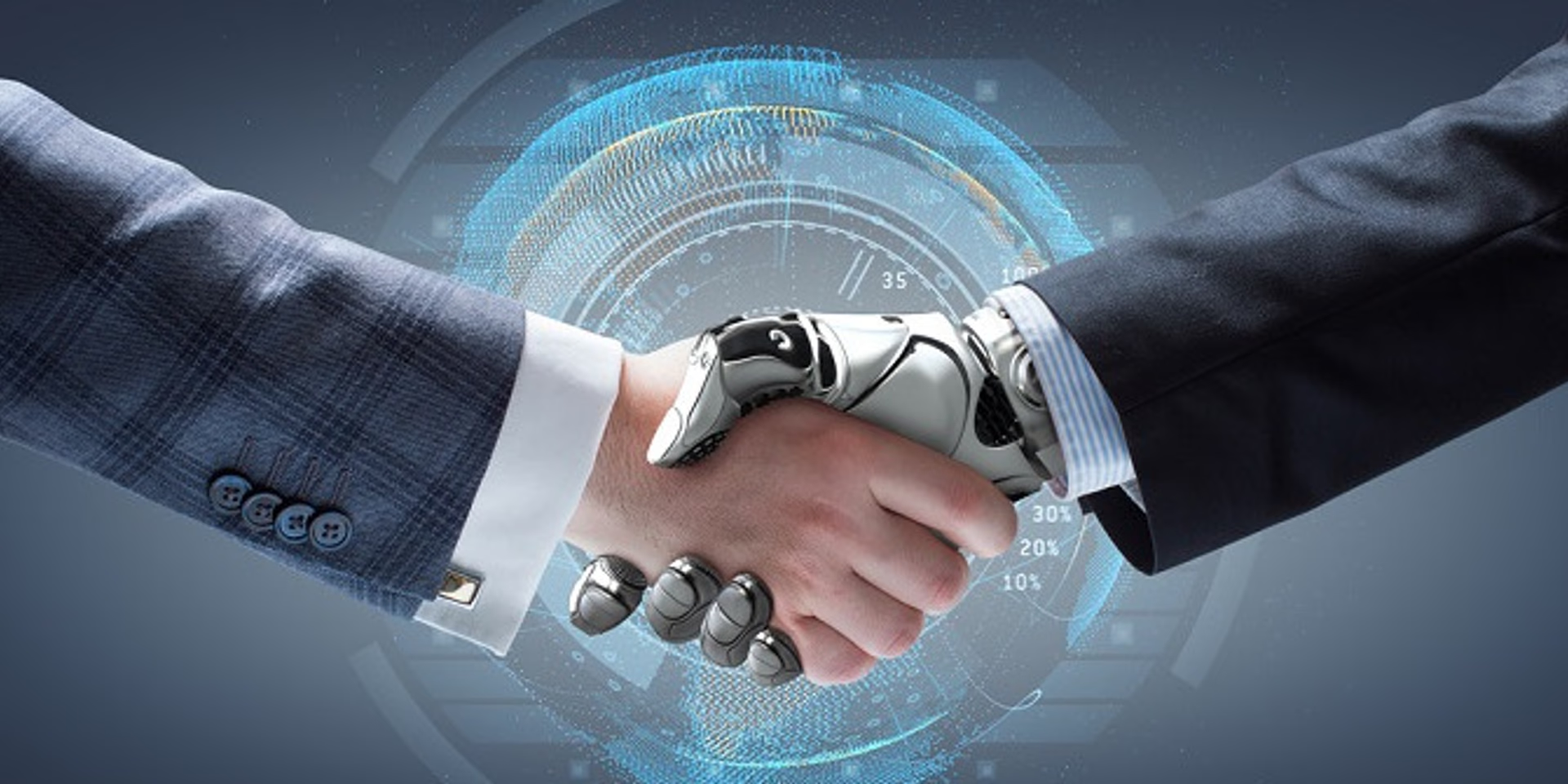
The future workplace is expected to emphasize partnership between humans and intelligent machines rather than complete replacement.
AI in Everyday Life
Within the next decade, AI could become deeply integrated into ordinary routines.
People may use AI for:
- Personalized shopping recommendations
- Smart home automation
- Travel planning
- Health monitoring
- Financial management
- Language translation
- Entertainment recommendations
- Education and tutoring
Many interactions may become so seamless that users no longer consciously recognize AI operating behind the scenes.
Artificial General Intelligence
Researchers continue exploring Artificial General Intelligence (AGI), a theoretical form of AI capable of performing a wide variety of intellectual tasks at human-like levels.
While today’s AI systems excel in specialized domains, AGI would possess broader reasoning and adaptability across many contexts. Opinions differ on when—or whether—AGI will be achieved, but ongoing research continues to push the boundaries of machine intelligence.
Global Competition in AI
Nations around the world view AI as a strategic technology with economic and security implications.
Competition focuses on:
- Research leadership
- Semiconductor manufacturing
- Talent development
- Data infrastructure
- Military applications
- National innovation strategies
International cooperation will also be important to establish standards that promote safety, interoperability, and responsible development.
Preparing for an AI-Driven Future
Individuals and organizations can take practical steps to prepare:
- Learn basic AI concepts and digital literacy.
- Develop analytical and creative problem-solving skills.
- Use AI tools responsibly to improve productivity.
- Stay informed about ethical and regulatory developments.
- Invest in continuous education and professional development.
- Protect personal data and cybersecurity practices.
- Encourage transparency and accountability when deploying AI systems.
The Road Ahead
Artificial intelligence is unlikely to replace human intelligence entirely. Instead, it will augment human capabilities, enabling people to solve larger problems and accomplish more with fewer resources.
Industries will continue evolving as AI handles repetitive tasks while humans focus on innovation, strategy, empathy, and complex decision-making. Governments, educators, businesses, and individuals all have roles to play in ensuring AI is developed responsibly and benefits society as a whole.
Conclusion
The future of artificial intelligence is filled with remarkable possibilities. From revolutionizing healthcare and education to transforming business operations and scientific research, AI has the potential to improve productivity, unlock creativity, and solve some of humanity’s greatest challenges.
However, realizing these benefits requires thoughtful governance, ethical design, and collaboration across sectors. Addressing concerns related to privacy, fairness, transparency, and employment will be essential to building public trust and ensuring equitable outcomes.
As AI becomes increasingly integrated into everyday life, success will depend not only on technological innovation but also on how effectively people adapt, learn, and work alongside intelligent systems. Those who embrace lifelong learning and responsible AI practices will be well positioned to thrive in a future where human ingenuity and artificial intelligence complement one another.