Introduction
Artificial intelligence (AI) is no longer a technology reserved for large corporations with massive budgets. Today, businesses of every size can use AI-powered tools to automate repetitive tasks, improve customer service, increase productivity, and make smarter decisions based on data. For small businesses, (AI Tools for Small Businesses)AI offers an opportunity to compete with larger companies without hiring large teams or spending a fortune on software.
From creating marketing content to managing customer support and analyzing sales trends, AI tools are transforming the way entrepreneurs operate. Whether you own an online store, a local retail shop, a digital agency, a restaurant, or a freelance business, AI can simplify daily operations and help you focus on growth.
This guide explores the best uses of AI for small businesses, its benefits, challenges, popular categories of tools, implementation strategies, and future trends.
What Are AI Tools?
AI tools are software applications that use technologies such as machine learning, natural language processing, and automation to perform tasks that typically require human intelligence. These tasks may include writing text, generating images, answering customer questions, recognizing patterns in data, forecasting trends, translating languages, and much more.
Unlike traditional software that follows fixed rules, many AI systems learn from data and improve their performance over time. This makes them valuable for businesses looking to streamline operations and adapt quickly to changing market conditions.
Why Small Businesses Should Use AI
Small business owners often face limited budgets, small teams, and intense competition. AI helps overcome these challenges by increasing efficiency and reducing manual work.
Key benefits include:
- Saving time through automation.
- Lowering operational costs.
- Improving customer experiences.
- Enhancing marketing performance.
- Supporting better business decisions.
- Increasing employee productivity.
- Reducing repetitive administrative tasks.
- Enabling 24/7 customer interactions.
AI allows entrepreneurs to focus on innovation and strategic planning rather than routine work.
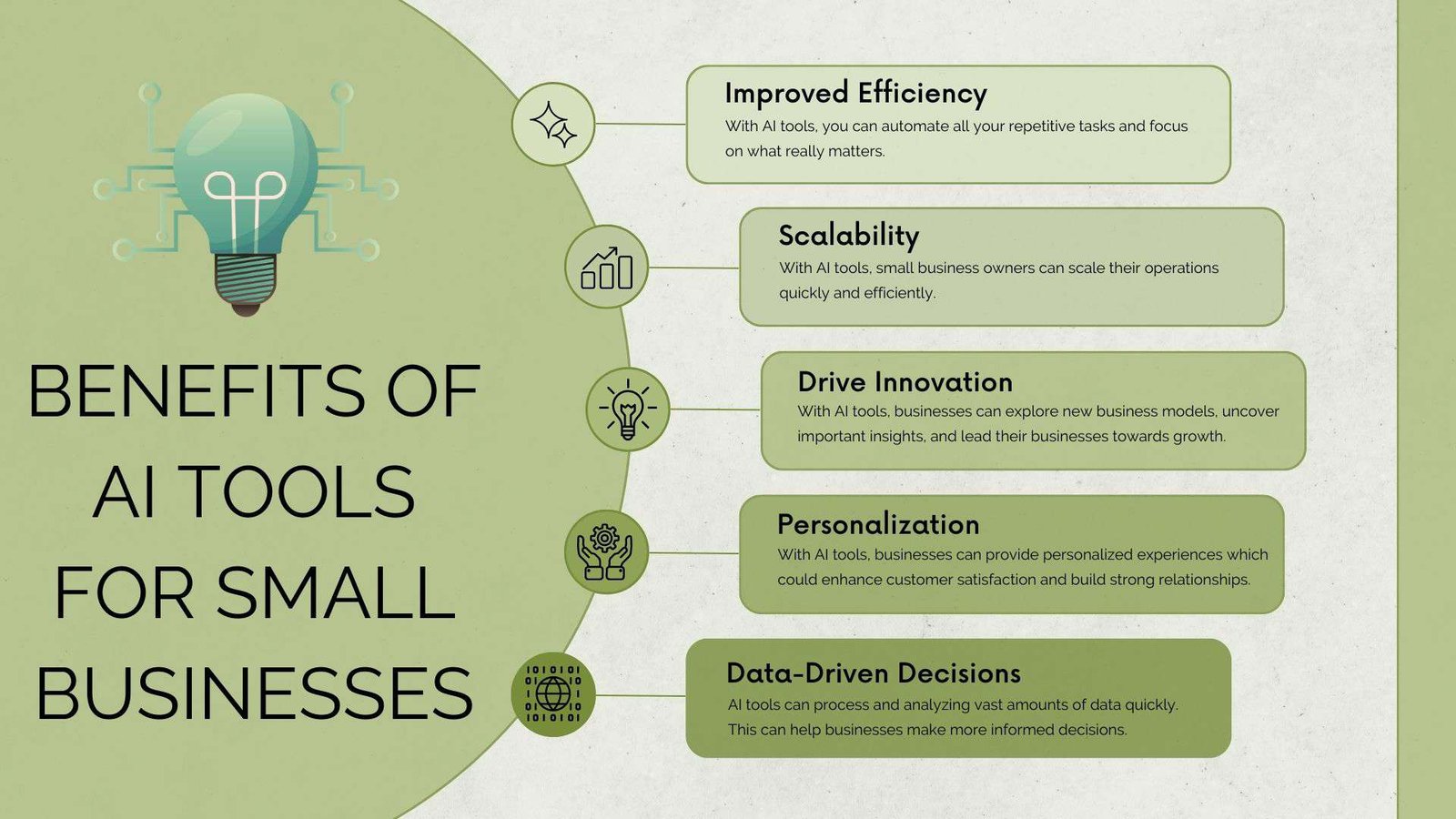
Top Benefits of AI for Small Businesses
1. Increased Productivity
Many daily activities such as scheduling appointments, writing emails, organizing documents, and generating reports can be automated using AI. Employees spend less time on repetitive tasks and more time on activities that create value.
2. Cost Savings
Hiring additional staff can be expensive. AI software can perform many support functions at a fraction of the cost, making it especially useful for startups and growing companies.
3. Better Customer Service
AI-powered chatbots and virtual assistants can answer common questions, process simple requests, and provide instant responses around the clock. This improves customer satisfaction while reducing support workloads.
4. Smarter Marketing
AI helps create personalized marketing campaigns, analyze customer behavior, optimize advertisements, and generate engaging content for blogs and social media.
5. Data-Driven Decisions
Modern AI systems analyze large datasets and identify trends that humans might overlook. Business owners can use these insights to improve pricing, inventory management, and customer targeting.
6. Improved Sales Performance
Sales teams can use AI to qualify leads, predict customer interests, automate follow-ups, and recommend products based on purchasing behavior.
Popular Categories of AI Tools
AI Writing Assistants
These tools help create articles, emails, product descriptions, advertisements, newsletters, and website content. They speed up content production while maintaining consistency.
Typical uses include:
- Blog writing
- SEO content creation
- Email campaigns
- Social media captions
- Product descriptions
- Business proposals
AI Image Generators
Businesses can create marketing graphics, social media visuals, presentations, advertisements, and concept designs without hiring professional designers for every project.
AI Video Creation Tools
AI can generate promotional videos, training materials, explainers, and short-form content for social media platforms.
AI Chatbots
Chatbots provide automated customer support, answer FAQs, collect contact information, and assist users outside business hours.
AI Accounting Tools
Financial AI solutions assist with invoice processing, expense tracking, bookkeeping, forecasting, and fraud detection.
AI CRM Systems
Customer relationship management platforms enhanced with AI help prioritize leads, predict customer churn, automate communications, and personalize interactions.
AI Email Assistants
These applications draft emails, summarize conversations, suggest replies, and organize inboxes efficiently.
AI Meeting Assistants
Meeting assistants automatically record discussions, generate summaries, capture action items, and create searchable notes.
AI Analytics Platforms
These systems process business data to identify trends, forecast demand, and provide actionable recommendations.
How AI Helps Different Types of Small Businesses
Retail Stores
Retail businesses use AI to optimize inventory, forecast demand, personalize promotions, and improve customer engagement.
Benefits include:
- Better stock management
- Dynamic pricing
- Customer recommendations
- Sales forecasting
- Marketing automation
Restaurants
Restaurants can use AI for menu recommendations, reservation management, customer service chatbots, demand prediction, and online ordering optimization.
E-commerce Businesses
Online stores benefit significantly from AI through:
- Personalized product suggestions
- Automated customer support
- Fraud prevention
- Inventory forecasting
- Marketing optimization
- Review analysis
Service Businesses
Consultants, agencies, and freelancers use AI to automate proposals, generate reports, manage schedules, and create client communications.
Healthcare Clinics
Small clinics can improve appointment scheduling, documentation, billing workflows, and patient communication with AI-assisted systems while maintaining appropriate privacy safeguards.
Real Estate Agencies
AI assists with property descriptions, lead generation, customer segmentation, virtual assistants, and market analysis.
AI for Marketing
Marketing is one of the areas where AI provides the fastest return on investment.
Content Creation
AI can generate:
- Blog posts
- Landing pages
- Email newsletters
- Advertising copy
- Video scripts
- Product descriptions
Social Media Management
AI helps plan posting schedules, suggest hashtags, generate captions, analyze engagement, and recommend improvements.
Search Engine Optimization
AI tools assist with:
- Keyword research
- Meta descriptions
- Topic clustering
- Content optimization
- Competitor analysis
- Internal linking suggestions
Paid Advertising
AI platforms optimize advertising campaigns by analyzing audience behavior and adjusting bids and targeting for improved performance.
AI for Customer Support
Customers increasingly expect instant responses. AI-powered support solutions provide assistance 24 hours a day.
Capabilities include:
- Answering common questions
- Order tracking
- Appointment booking
- Refund guidance
- Product recommendations
- Ticket routing
- Language translation
Human representatives can then focus on more complex issues.
AI for Human Resources
Small businesses with growing teams can automate many HR tasks.
Applications include:
- Resume screening
- Interview scheduling
- Employee onboarding
- Performance tracking
- Internal knowledge management
- Training recommendations
This reduces administrative burden and speeds up hiring processes.
AI for Finance and Accounting
Managing finances accurately is essential for every business.
AI helps by:
- Categorizing expenses
- Generating invoices
- Monitoring cash flow
- Detecting unusual transactions
- Forecasting budgets
- Reconciling accounts
- Preparing financial reports
Business owners gain better visibility into company performance.
AI for Sales
Sales professionals can increase efficiency through AI-assisted workflows.
Examples include:
- Lead scoring
- Customer segmentation
- Automated outreach
- Proposal generation
- Predictive analytics
- Follow-up reminders
- Opportunity forecasting
AI identifies promising prospects and supports stronger customer relationships.
Choosing the Right AI Tool
Before selecting an AI solution, evaluate the following factors:
Business Needs
Identify the specific problems you want to solve rather than adopting AI simply because it is popular.
Ease of Use
Choose software with intuitive interfaces and minimal training requirements.
Integration
Verify compatibility with your existing systems, including accounting software, CRM platforms, email providers, and e-commerce tools.
Scalability
Select tools that can grow alongside your business.
Security
Review privacy policies, data handling practices, and access controls before uploading sensitive information.
Cost
Consider subscription fees, implementation costs, support expenses, and expected productivity gains.
Steps to Implement AI Successfully
Step 1: Define Objectives
Set measurable goals such as reducing customer response times, increasing website traffic, or automating repetitive tasks.
Step 2: Start Small
Launch a pilot project with one department before expanding AI across the organization.
Step 3: Train Employees
Provide guidance on how to use AI responsibly and effectively.
Step 4: Monitor Performance
Track key metrics and compare results against your original objectives.
Step 5: Improve Continuously
Regularly review workflows and adjust prompts, automations, or configurations based on business needs.
Common Challenges
Although AI offers many advantages, businesses may encounter obstacles.
Data Quality
Poor or incomplete data can reduce the accuracy of AI-generated outputs.
Employee Adoption
Staff members may require training before they become comfortable using new technologies.
Privacy Concerns
Businesses should ensure compliance with applicable laws and protect customer information appropriately.
Overreliance on Automation
AI-generated work should be reviewed by humans, particularly for legal, financial, or high-impact decisions.
Integration Complexity
Some legacy systems may require additional customization to work effectively with AI solutions.
Best Practices
To maximize value:
- Review AI-generated content before publishing.
- Keep software updated.
- Protect sensitive information.
- Combine human expertise with automation.
- Test outputs regularly.
- Monitor business metrics.
- Maintain transparency with customers where appropriate.
- Establish clear internal policies for AI usage.
Future Trends
AI technology continues to evolve rapidly. Small businesses should watch for developments such as:
- More advanced conversational assistants.
- Voice-enabled customer interactions.
- Personalized shopping experiences.
- Automated business intelligence dashboards.
- AI-powered cybersecurity systems.
- Predictive inventory management.
- Smarter workflow automation.
- Enhanced multilingual communication.
These innovations are expected to become more affordable and accessible over time.
Frequently Asked Questions
Is AI affordable for small businesses?
Yes. Many AI platforms offer free plans or low-cost subscriptions suitable for startups and small organizations.
Can AI replace employees?
AI is generally most effective as a productivity tool that assists employees with repetitive work, allowing people to focus on creative thinking, relationship building, and strategic decision-making.
Is technical expertise required?
Many modern AI applications are designed for non-technical users and include user-friendly interfaces with guided workflows.
Can AI improve customer satisfaction?
Yes. Faster response times, personalized recommendations, and round-the-clock availability often contribute to better customer experiences.
Is AI secure?
Security depends on the provider and implementation. Businesses should choose reputable vendors, use strong access controls, and avoid sharing unnecessary sensitive data.
Conclusion
Artificial intelligence is changing the competitive landscape for small businesses by making advanced capabilities available to organizations of every size. Whether the goal is improving customer support, creating content faster, automating accounting, enhancing marketing campaigns, or analyzing business performance, AI offers practical solutions that can increase efficiency and reduce costs.
The most successful businesses approach AI strategically: they identify real problems, start with manageable projects, train their teams, and continuously evaluate results. Rather than replacing human judgment, AI serves as a powerful assistant that helps business owners make informed decisions and operate more effectively.
As technology continues to advance, adopting AI thoughtfully can provide a significant competitive advantage. Small businesses that embrace automation while maintaining strong customer relationships and human oversight are well positioned to thrive in an increasingly digital economy.